

Your Ultimate Guide to Job Grants Canada for Small Businesses

Think of job grants as a co-investment from the government directly into your team. These programs are designed to offset your payroll costs, making it easier for small and medium-sized businesses to bring on new talent or upskill existing staff. Best of all, it's non-dilutive funding—meaning you don't give up any equity or take on debt.
How Job Grants Can Supercharge Your Business
What if you had a partner helping to cover your team's salaries? That's the core idea behind job grants and wage subsidies in Canada. These aren't just handouts; they're strategic tools designed to help you scale your operations, innovate, and get a leg up on the competition.
It’s a bit like a co-op program, but for your entire company. The government chips in to share the cost of hiring skilled people for your team, which significantly lowers the financial risk of expanding your workforce.
Shift Your Payroll from a Cost to an Investment
For most small businesses, payroll is the biggest line item on the budget. It’s often the very thing that stops you from growing. You know you need more hands on deck to build that next feature or crack a new market, but the upfront cost feels impossible.
This is where job grants completely change the game.
By subsidizing a portion of a new hire's wages, these programs turn your biggest expense into a strategic investment. Suddenly, that top-tier software developer or seasoned marketing lead you thought was out of your league becomes a realistic, affordable hire who can start delivering value right away.
This frees you up to focus on what really matters: building a powerhouse team that can drive your business forward.
The Real-World Impact of Landing a Job Grant
Getting a job grant does more than just pad your bank account. The positive effects create a ripple effect that can be felt across your entire organization.
Here are a few ways these funds can immediately benefit your business:
- Expand Faster: Hire the sales, marketing, and operations people you need to enter new markets sooner than you ever thought possible.
- De-Risk Your Hiring: Take the financial pressure off onboarding new team members. This lets you build your dream team with more confidence and less cash flow anxiety.
- Attract Top Talent: Offer more competitive salaries to attract the highly skilled professionals you need to grow, knowing that a portion of the cost is covered.
- Fuel Innovation: Bring on specialized talent—like R&D experts or engineers—to speed up product development and keep you ahead of the curve.
At the end of the day, job grants in Canada provide the capital to close the gap between where your business is today and where you want it to be. They empower you to invest in your most important asset—your people—and unlock that next crucial stage of growth.
Finding Your Way Through Canadian Hiring Grants
Trying to find the right government funding can feel like you've been dropped into a dense forest without a map. There are paths leading everywhere, but which one is right for your business? To find the job grants Canada has available, you need to understand the lay of the land.
Think of the grant system as having three main levels: broad federal programs at the top, more focused provincial initiatives in the middle, and highly specialized grants at the base. Knowing how to navigate and combine these layers is the secret to building a truly effective funding strategy.
It all comes down to fueling your growth. When you secure funding to offset payroll costs, you free up capital to expand your team, which is the engine that drives innovation and takes your business to the next level.
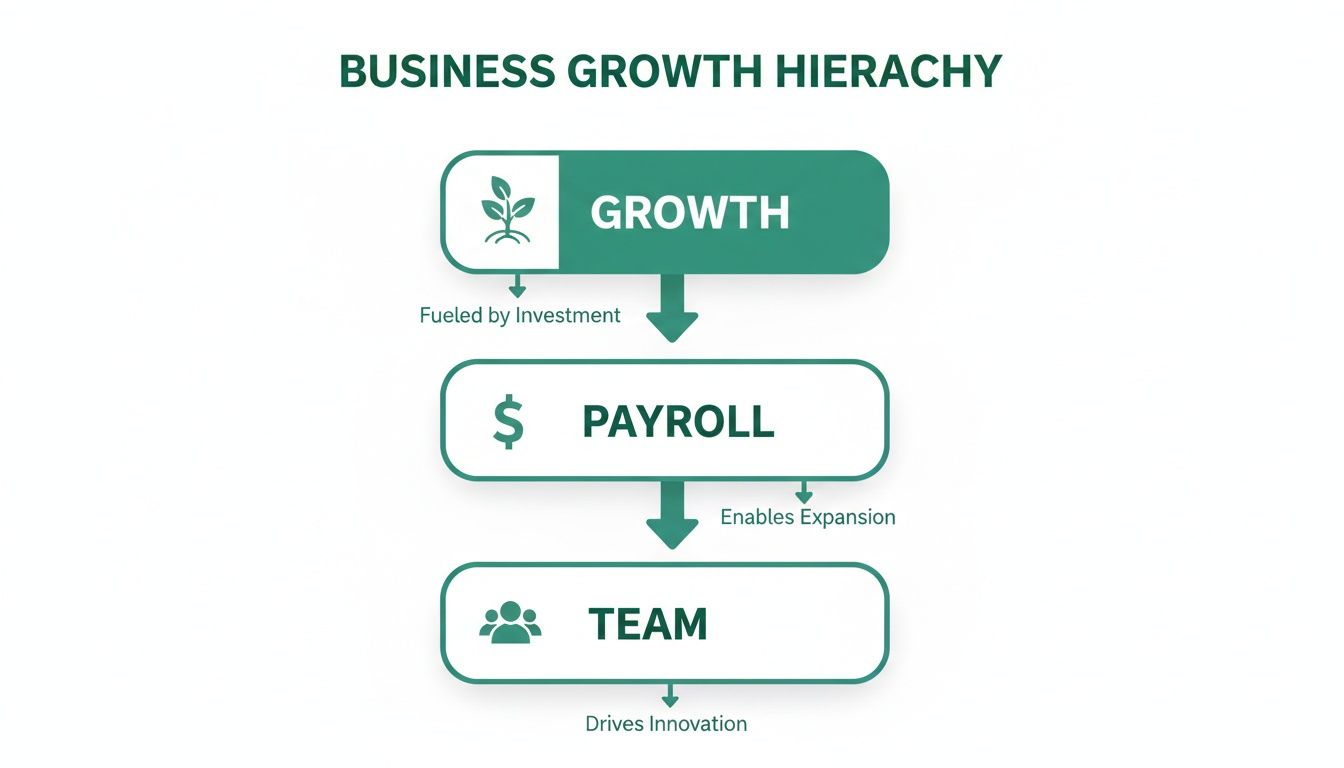
This is the core idea: by reducing the financial burden of hiring, you're not just adding headcount. You're investing directly into your company's capacity to innovate and grow.
The Federal Layer: The Big Picture
At the highest level, you have federal grants. These are the big, national programs designed to tackle Canada-wide goals, like boosting youth employment, driving innovation, or upskilling the workforce. The best part? They’re generally open to businesses no matter which province or territory you call home.
A perfect example is the Canada Summer Jobs (CSJ) program. This isn't some small initiative; between 2019 and 2023, it helped fund over 460,000 jobs for young people. CSJ gives wage subsidies to employers who hire students between 15 and 30, helping a new generation get their foot in the door with real-world work experience. The Auditor General’s report on youth employment programs gives a great overview of its impact.
Other major federal players include:
- Student Work Placement Program (SWPP): Helps cover the wages for post-secondary students in paid work placements related to their field of study.
- Youth Employment and Skills Strategy (YESS): Funds organizations that help young Canadians, especially those facing barriers, find and keep good jobs.
These programs are a fantastic starting point, but the real magic happens when you start stacking them with more localized opportunities.
Provincial and Territorial Programs: Your Regional Advantage
One level down, you'll find grants offered by your provincial or territorial government. These are much more tailored, designed to address the unique economic needs of each region. They often zero in on key local industries—think tech in British Columbia, manufacturing in Quebec, or green energy in Alberta.
So, a startup in Vancouver might tap into a fund specifically meant to attract top-tier software engineers. At the same time, a factory in Sherbrooke could get support to train its staff on state-of-the-art automation equipment.
Provincial grants align your hiring needs directly with the local government’s economic roadmap. When your project helps them meet their goals, your application has a much stronger chance of success.
These programs are so powerful because they're designed to solve immediate, local labour shortages. For businesses in Ontario, a key program to look into is the Canada-Ontario Job Grant, which gives employers a hand in paying for employee training.
Sector-Specific and Niche Grants: The Final Piece
At the most targeted level are the niche grants. These are often run by industry associations, non-profits, or very specific government departments to support a particular sector or demographic.
You might find funding for things like:
- Hiring and training apprentices in the skilled trades.
- Bringing on a PhD for a highly specialized clean-tech research project.
- Creating job opportunities through Indigenous employment programs.
- Making your workplace more accessible by hiring persons with disabilities.
While these grants are incredibly specific, they can offer significant, game-changing support if your business fits the mould. By pulling from all three tiers—federal, provincial, and sectoral—you can weave together a comprehensive funding strategy that dramatically lowers your payroll costs and puts your growth on the fast track.
Qualifying For and Winning Your First Grant
Alright, let's move from theory to action. This is the exciting part. Securing that first job grant might seem like a huge mountain to climb, but it’s really just a series of small, manageable steps. The key to a winning application is simply understanding the rules of the game—both for your company and for the person you want to bring on board.

This isn’t about just jumping through bureaucratic hoops. It’s about drawing a clear, logical line between the money you’re asking for and the positive impact it will create for your business and a new employee. Think of it like telling a story: your new hire is the hero, and the grant is the tool that helps them—and your company—succeed.
Understanding the Eligibility Puzzle
Before you even dream of filling out an application, you need to make sure you're in the right ballpark. Grant programs almost always have two distinct sets of criteria to meet: one for your business and one for the employee you’re looking to hire.
Funders want to see that your business is stable and legitimate. It’s their way of managing risk. Common requirements include:
- Being a Canadian-Controlled Private Corporation (CCPC): This is standard practice to ensure the funding stays in Canada and supports domestic businesses.
- Having a Business Number: You must be properly registered with the Canada Revenue Agency (CRA).
- Maintaining Good Standing: This just means you’re up-to-date on your taxes and are following all the relevant labour laws.
- Possessing Adequate Insurance: Most programs will ask for proof of WSIB/WCB and third-party liability insurance. No surprises there.
The criteria for the potential employee are usually tied directly to the program’s specific social or economic goals. You’ll often see grants that are laser-focused on hiring from certain groups:
- Youth: This is a big one. It typically means individuals aged 15-30.
- Recent Graduates: Someone who has finished post-secondary education in the last couple of years.
- Underrepresented Groups: This can be a broad category, including Indigenous peoples, persons with disabilities, newcomers to Canada, or visible minorities.
- Net New Hires: This is crucial. Many grants insist that the role must be a new addition to your team, not just a backfill for someone who was recently let go.
Your Application Journey from Start to Finish
Once you've ticked off the eligibility boxes, the actual application process tends to follow a fairly predictable path. If you break it down into a checklist, it becomes much less overwhelming and far more achievable.
Find the Perfect Grant: This is step one for a reason. You need to find a program that actually aligns with what you’re trying to do. Hiring a summer student? The Canada Summer Jobs program is a no-brainer. Need to upskill your existing team? Look for a training-focused grant like the Canada-Ontario Job Grant.
Assemble Your Documents: This is the prep work that will save you a world of headaches later. Get your business registration papers, insurance certificates, and recent financial statements all in one place. Trust me, you'll thank yourself for being organized.
Craft a Compelling Proposal: This is your moment to make your case. Don't just list job duties. Clearly explain the role, what the candidate will be doing, and how this new position is going to fuel your company’s growth. If you want to really elevate your proposal, check out our guide on successful grant writing opportunities for some advanced techniques.
Develop a Simple Training Plan: Many grants, especially those geared toward younger hires, require a basic training or mentorship plan. This doesn't need to be a novel. A simple one-page outline showing onboarding tasks, key learning goals, and planned mentorship check-ins is often more than enough.
Submit and Wait (Patiently): Get your application in well before the deadline. Review times can be anything from a few weeks to a few months, so you need to factor that into your hiring timeline. And here's the golden rule: do not hire the candidate until you have official, written approval.
A Real-World Example in Action
Let's make this tangible. Imagine a small tech startup in Toronto—we'll call them "Innovate Inc." They want to hire their first junior data analyst. They're bootstrapping, so every dollar counts. After some searching, they find a provincial youth employment grant that will subsidize 50% of wages for new hires under 30.
Their strategy is simple but brilliant: they align every single part of their application with the grant's stated mission of "providing meaningful career-launching opportunities for young professionals in the tech sector."
Their job description isn’t just a list of tasks. It highlights mentorship from their senior developer and the chance to work on projects that will actually ship. Their training plan includes weekly one-on-ones, a small budget for online data science courses, and a capstone project they can add to their portfolio.
By framing the role as a genuine growth opportunity and not just a job, Innovate Inc. is speaking the funder's language. This simple shift in perspective dramatically boosts their chances of getting approved, and it’s the secret to winning the best job grants Canada has to offer.
Finding the Right Grant Without The Guesswork
Looking for the right job grant can feel like you’re panning for gold in a river of information. You spend hours sifting through one government website after another, each with its own confusing layout and jargon, just hoping to find that one golden nugget of funding that actually fits your business. It's not just exhausting; it’s a terribly inefficient way to operate.
The old way of doing things is packed with guesswork. You might start with a broad search like "job grants Canada," which lands you on a massive government portal. From there, you're stuck for the rest of the day clicking through links, downloading PDFs, and trying to make sense of dense eligibility rules. It's a frustrating maze that often ends with missed opportunities and a lot of wasted time.
But what if you could skip all that manual labour and get straight to the programs you actually qualify for? That's exactly what modern, specialized grant-finding platforms are designed to do.
A Smarter Way to Search for Funding
Instead of you having to hunt for grants, these tools bring the right grants directly to you. Think of it like this: it's the difference between manually scrolling through thousands of online dating profiles and using a matching algorithm that shows you your most compatible options first.
Platforms like GrantFlow take your business profile—your industry, province, size, and hiring goals—and scan a huge, constantly updated database of funding programs. They instantly filter out all the noise and give you a clean, curated list of grants you’re likely eligible for, often with a "match score" to help you prioritize.
The screenshot below gives you a feel for a typical dashboard, where your best-fit grants are laid out clearly. It saves you from that overwhelming feeling of staring at an endless list of government links.
This kind of streamlined view lets you see your top matches, their deadlines, and funding amounts all in one place. What used to be a multi-day research headache becomes a quick, actionable review.
This strategic approach turns your funding search from a painful chore into a proactive business advantage. You can finally stop wasting time on dead ends and start putting your energy toward the grants you have the best shot at winning.
Thinking Beyond Basic Wage Subsidies
A winning funding strategy means looking beyond the most obvious options. Wage subsidies for new hires are great, don’t get me wrong, but they're just one piece of the puzzle. The world of job grants in Canada is much richer than that, with support available for all sorts of business activities.
Too many businesses miss out on valuable opportunities because they get tunnel vision, focusing only on simple hiring grants. But honestly, some of the most powerful programs are the ones designed to support employee development and innovation.
The most successful companies don't just find grants to fill seats. They find grants that build capabilities, accelerate innovation, and create a more skilled, resilient workforce for the long term.
Think about these often-overlooked grant categories:
- Training Grants: These programs help you cover the cost of upskilling your current team or providing crucial training for new hires. Programs like the Canada-Ontario Job Grant can cover a big chunk of third-party training fees, making professional development so much more affordable.
- R&D Hiring Funds: If your business is innovating, there are specific grants to help you hire specialized talent like researchers, engineers, and scientists. These often come with very generous subsidies for high-skilled roles.
- Co-op and Internship Subsidies: Programs like the Student Work Placement Program (SWPP) offer fantastic funding to businesses that give post-secondary students meaningful work experience. It’s a brilliant way to build a pipeline of future talent.
Canada's nonprofit sector figured this out a long time ago. Data from Statistics Canada shows that nonprofits consistently rely on a mix of grant streams to create and keep thousands of jobs going. You can learn more about how they do it by exploring insights on Canada's nonprofit workforce. This same strategic thinking is available to small businesses that use platforms to track the full range of employment incentives, from federal wage subsidies to niche provincial programs.
At the end of the day, finding the right grant isn't about luck. It's about having the right tools and the right strategy. By using a grant finder and widening your search beyond basic subsidies, you can uncover hidden gems that align perfectly with your company's growth plan. When you're ready to dig deeper, you can also explore our detailed guide on grants for small businesses to get started.
How Canadian Businesses Win With Job Grants
It's one thing to talk about the theory of job grants, but it’s another to see them in action. The real magic happens when you see how these programs empower actual Canadian businesses, turning ambitious hiring goals into tangible results. This isn't just about saving a few dollars; it's about fuelling real, measurable growth.
Let's look at a few stories of how companies are using job grants in Canada to do some pretty amazing things.

These aren't just one-off wins. They show a repeatable formula for growth that your business can tap into by being smart about the funding available.
The Marketing Agency That Doubled Its Intern Program
Picture a mid-sized digital marketing agency in Halifax. They had a problem many growing businesses face: their client list was expanding, but their budget for bringing on junior talent was stretched thin. They knew their internship program was a great source of talent but couldn't afford to double its size alone.
The answer was a provincial co-op grant aimed at creating work-integrated learning opportunities. By securing funding that covered 50% of the interns' wages, the agency went from hiring three students to six.
The results were immediate:
- More Hands on Deck: The bigger team meant they could take on three new client projects, which bumped their quarterly revenue by 15%.
- A Stronger Talent Pipeline: They spotted two star performers and offered them full-time jobs after graduation, saving a bundle on future recruitment costs.
- A Culture of Mentorship: Senior staff got to flex their leadership muscles by mentoring the new interns, which boosted morale across the board.
The Clean-Tech Startup That Accelerated Innovation
Out in British Columbia, a small clean-tech startup was on the verge of a breakthrough in battery technology but hit a wall. Their team was brilliant, but they were missing the niche scientific expertise needed to crack a tough chemical engineering problem. Hiring a PhD-level researcher felt completely out of reach financially.
They found their solution in a federal innovation fund designed to bridge the gap between industry and academia. These programs are no small matter; Innovation, Science and Economic Development Canada has committed huge sums, like the $218,117,000 given to Mitacs, for exactly these kinds of high-skilled placements. You can dig into these large-scale federal grant contributions on open.canada.ca.
By landing a grant that subsidized a PhD graduate’s salary, the startup brought in a specialist who solved their critical R&D puzzle in just six months. They had originally budgeted over a year for that task.
This wasn’t just about adding a person to the team. It was about buying time. This strategic hire shaved months off their product development timeline, putting them in a prime position to secure their next round of venture capital funding well ahead of schedule.
The Retailer That Conquered the Seasonal Rush
Finally, let’s go to a local garden centre in an Ontario tourist town. Every summer, they were swamped with customers but couldn't find—or afford—enough reliable seasonal help. This bottleneck was capping their sales during their busiest, most critical months.
They looked into the Canada Summer Jobs (CSJ) program. Through this federal initiative, they received a wage subsidy that let them hire four students for the peak season. The new hires took over inventory, helped customers, and ran the cash registers, which freed up the owner to focus on bigger-picture tasks like managing suppliers and marketing.
The outcome? The garden centre had its best summer ever, with sales climbing 20% over the previous year. And on top of that, they gave four local students a great first-job experience.
Common Mistakes to Avoid When Applying for Grants
A rejected grant application isn't just a disappointment—it's a huge waste of your time and energy. Getting your hands on job grants in Canada often boils down to steering clear of a few common, but surprisingly critical, mistakes. If you approach the application process with the same focus you give your core business, you’re already halfway there.
I’ve seen too many business owners stumble over preventable slip-ups. We’re not talking about major strategic blunders here, but simple oversights that can get an otherwise solid application tossed in the “no” pile right away. Knowing what these pitfalls are ahead of time is the best defence.
Not Reading the Fine Print
One of the fastest tracks to rejection is simply not understanding the rules. It’s easy to get excited about a grant that looks like a perfect match, only to find a deal-breaker buried deep in the program guide. You might discover your company is just a bit too big, operates in the wrong industry, or that the specific role you’re hiring for doesn't qualify.
Proactive Solution: Before you type a single word of the application, create a quick checklist based on the program's official guidelines. Go through it and tick off every single requirement for both your business and the role. This five-minute check can easily save you five hours of wasted work.
It’s a simple discipline that ensures you’re only chasing opportunities you actually have a shot at winning.
Hiring Before You Get Approval
This is the absolute golden rule of wage subsidies: never, ever hire a candidate before you have official, written approval from the organization funding the grant. I know it’s tempting, especially when you’ve found the perfect person and you’re eager to get them started.
But here’s the thing: most job grants exist to create new jobs. If you hire someone before getting the green light, it tells the funder that you would have created that position anyway, with or without their money. That completely undermines the point of the program from their perspective and is an almost guaranteed disqualification.
- Wait for the official confirmation letter or signed agreement. A verbal heads-up or an email saying you'll "likely be approved" is not enough.
- Build the approval timeline right into your hiring process. Be upfront with candidates, letting them know that the start date is conditional on securing the grant.
Missing Deadlines and Incomplete Paperwork
Government programs operate on strict schedules. A deadline isn't a suggestion; it's a hard stop. Submitting your application even one minute late usually means it won't even be looked at. The same goes for incomplete applications—missing signatures, forgotten documents, or unanswered questions are often grounds for immediate dismissal.
The easiest way to stay on top of this is with a simple tracking system. A basic spreadsheet can work wonders.
| Grant Name | Deadline | Status | Required Documents |
|---|---|---|---|
| Canada Summer Jobs | Jan 10 | In Progress | Business Number, Insurance |
| SWPP Grant | Rolling | Submitted | Training Plan, Job Description |
This kind of organized approach makes sure nothing slips through the cracks. It also sets you up for success with reporting and record-keeping later on, which is vital for staying compliant once you actually get the funds. By side-stepping these common blunders, you shift from being just another hopeful applicant to a prepared and successful one.
Got Questions About Canadian Job Grants? We’ve Got Answers.
When you’re diving into the world of government funding, a few questions are bound to pop up. It’s a new landscape for many business owners. Let's tackle some of the most common ones so you can feel confident as you move forward.
Can I Get More Than One Grant for the Same Employee?
This is a great question, and one we hear all the time. The short answer is yes, you often can, but there's a critical rule to follow. This strategy, known as grant stacking, is usually fine as long as you aren’t using money from two different federal programs to pay for the exact same thing.
For example, you could absolutely use a federal wage subsidy to help cover a new hire's salary and, at the same time, use a provincial training grant to pay for a specific certification course for that same person. See the difference? One grant covers wages, the other covers a separate training cost. Just be sure to read the fine print for each program, as they’ll always spell out their specific rules on stacking.
Is a Grant Just Another Word for a Loan?
Not at all, and this is the best part. A grant is not a loan. Grants are non-repayable funds. The money is yours to keep, with no expectation of paying it back. Think of it as a direct investment in your business to help you hire, train, or expand.
A loan is debt. It shows up on your balance sheet and has to be repaid, almost always with interest. A grant, on the other hand, is a cash injection that fuels your growth without adding a penny of financial liability.
This is what makes securing a job grant in Canada so powerful. It’s a way to grow your team without taking on debt or giving up equity.
How Long Will I Be Waiting for an Answer?
This is where you need to be patient. Grant approval timelines are all over the map and depend entirely on the specific program. Some of the smaller, more straightforward applications can get a thumbs-up in as little as three to five weeks.
But for the bigger, more competitive federal programs, you could be waiting several months between the time you submit your application and when you finally get a decision. It’s crucial to build this waiting period into your plans. Don't hire someone expecting the grant to come through next week. Always plan for the longest timeline mentioned in the program guide to be safe.
What Kind of Paperwork Do I Need to Do Afterwards?
Getting the grant money isn’t the final step. The government agency that gave you the funding will need you to report back to show how you used it. This is standard practice—it’s how they make sure the money is having the intended impact.
Here’s the kind of reporting you can typically expect:
- Proof of Spending: You'll need to show where the money went. This means keeping clear records like payroll stubs for wages or paid invoices for training courses.
- Progress Updates: Many programs will ask for a short report—sometimes midway through, sometimes at the end—explaining what the employee accomplished, the skills they gained, and how it helped your business.
- Feedback from the Employee: For some grants, especially those geared toward students or youth, the new hire might be asked to fill out a quick survey about their work experience.
The key is to be organized from the very beginning. If you keep good records as you go, meeting these reporting requirements will be a breeze and keep you in good standing for the next time you apply.
Ready to stop searching and start winning? GrantFlow uses AI to instantly match your business with the right funding, from wage subsidies to R&D grants, so you never miss an opportunity. Find your perfect grant today.
Continue reading

Mastering Your 2026 Agenda for an Annual General Meeting
Draft a compliant agenda for an annual general meeting in Canada. Covers legal items, virtual meetings, & aligning your 2026 AGM with grant funding goals.

Grant Money for Disabled: A Canadian Funding Guide
Find grant money for disabled Canadians. Our 2026 guide covers federal & provincial benefits, business grants, eligibility, and how to apply successfully.

Home Improvement Grants Canada: A Complete 2026 Guide
Unlock Canadian home improvement grants in 2026. Our guide covers federal, provincial, and municipal funding for homeowners and businesses. Learn how to apply.