

Your Guide to Grant Writing Opportunities in Canada
Grant funding isn't just "free money." For Canadian small businesses, it's a powerful, non-dilutive engine for growth. This guide is all about reframing grant writing opportunities as a core part of your financial strategy—transforming it from a chore you dread into a genuine strategic advantage.
Why Grant Funding Is a Strategic Advantage
I get it. For many Canadian founders and operations managers, the world of grants feels like a bureaucratic maze built for non-profits or massive research labs. But thinking that way means you're overlooking a huge pool of capital that can scale your business without you giving up equity or taking on debt.
Billions of dollars are available every year through programs like the federal SR&ED and CDAP initiatives, not to mention countless targeted funds at the provincial and municipal levels.
The real problem isn't a lack of funding; it's a bottleneck caused by two things: discovery and resources. Sifting through government websites to find the right programs is a grind, and putting together a winning application takes focus—a luxury most small business teams just don't have. This is exactly where a systematic approach can change the game.

Unlocking Non-Dilutive Capital
Let's talk about non-dilutive funding. It's capital you don't pay back, and it doesn't water down your ownership stake. Frankly, it’s the cleanest money your business can get.
With grant funding, you can:
- Speed up innovation by covering the costs of R&D projects.
- Grow your team using wage subsidies that make hiring more affordable.
- Adopt new tech with programs specifically designed to improve digital capabilities.
- Break into new markets with support for export development activities.
Think of it this way: a grant is a strategic investment the government is making in your business because they believe in your potential to create jobs and drive the economy forward. And the scale of these investments can be massive.
Just look at the Spring 2025 CIHR Project Grant competition. It funnelled a staggering $411 million into 435 research grants. While that's focused on health research, it shows the sheer scale of capital available. The average funded project secured $943,340 over nearly five years. That kind of number shows how grant writing can unlock significant, long-term support. You can dig into the specifics by exploring the CIHR funding outcomes.
Overcoming Common Hurdles
For most small businesses, the two biggest roadblocks are awareness and efficiency. You can’t apply for a grant you don’t know exists, and you can’t win one if your application process is a slow, disorganized scramble.
This is precisely why a structured process, supported by modern tools, is no longer a "nice-to-have." It's essential.
By building a repeatable system for finding, qualifying, and applying for grants, you transform the process from a daunting task into a manageable and highly rewarding business function. This guide provides the playbook to build that system.
How to Systematically Uncover Grant Opportunities
The biggest roadblock to getting grant funding isn't the writing; it's finding the right opportunities in the first place. If you're stuck in a cycle of endless, frustrating Google searches, you're doing it wrong. A much smarter way is to build a repeatable, multi-layered system that keeps a steady stream of high-quality, relevant grants flowing into your pipeline.
This isn't about one magic website. It's about knowing where to look—from the big federal programs down to the hyper-local funds in your own city.
Start at the Top: Federal Grant Portals
The Government of Canada is the biggest player in the grant game, but their websites can feel like a maze. Your best starting point is usually the Innovation Canada digital platform. Think of it as a centralized hub designed to help businesses navigate the funding landscape.
Here's what you'll see on the Innovation Canada homepage, pointing you toward their business benefits finder.
The real value here is the guided search. It lets you filter programs by what you actually need, whether it's money for R&D, hiring new staff, or training your team.
But even with a "one-stop shop," it's easy to get overwhelmed. The trick is to be methodical. Run your searches regularly—don't just search once and forget about it. Block off time in your calendar every month to check for new programs and make sure you sign up for any email alerts they offer.
Drill Down to Provincial and Territorial Funds
While everyone chases the big federal dollars, the real gold is often found at the provincial level. Provincial and territorial governments offer a treasure trove of funding that's often less competitive because fewer people know about it. These programs are laser-focused on local economic goals, so if your business fits their agenda, you have a solid shot.
Every province has its own ecosystem of economic development agencies. For example:
- In Ontario, you should be regularly checking the Ontario Business Grants page and keeping tabs on organizations like the Ontario Centre of Innovation (OCI).
- Out in British Columbia, Innovate BC is the go-to for tech companies looking for funding to get their research and commercialization projects off the ground.
- If you're in Alberta, you need to have Alberta Innovates on your radar, as they support everything from health sciences to clean energy.
The key is to identify the main economic development body in your province and get on their mailing list. New grant writing opportunities are almost always announced there first.
Uncover Hyper-Local Municipal Grants
Don’t forget to look in your own backyard. Your local municipality likely offers small, highly targeted grants to boost the local economy. We're talking about things like storefront improvements, hiring a summer student, or upgrading your e-commerce site. These are often the easiest grants to win because you're only competing against other local businesses.
Start by digging around your local Economic Development Office's website. Look for pages titled "Business Resources," "Incentive Programs," or "Community Grants." A $5,000 grant might not sound like much, but it can make a huge difference in your day-to-day operations and help you build momentum for bigger applications.
I see so many businesses fixate on multi-million dollar federal grants while completely ignoring the low-hanging fruit at the local level. Landing a few small municipal grants provides quick cash flow and, more importantly, builds a track record of success that makes your future applications much stronger.
The Smart Way: Use an AI-Powered Aggregator
Let's be realistic. Manually checking dozens of websites every week just isn't sustainable for a busy business owner or consultant. This is where a dedicated grant aggregator becomes your secret weapon. Platforms like GrantFlow are built specifically to solve this discovery problem.
Instead of you hunting for grants, the right grants come directly to you. You set up a quick profile for your business—your industry, location, size, and what you need funding for—and the platform’s algorithm does the heavy lifting, scanning a massive database of Canadian programs for you.
This approach flips the script on the old, manual way of searching.
Navigating the grant landscape requires a multi-pronged approach. Each channel has its unique advantages and drawbacks, and the best strategy often involves using a mix of them. Here's a quick breakdown to help you decide where to focus your energy.
Grant Discovery Channels for Canadian Businesses
| Channel | Best For | Pros | Cons |
|---|---|---|---|
| Federal Portals | Businesses chasing major R&D, innovation, or export grants. | Can offer very large funding amounts. | Hyper-competitive; notoriously complex and long applications. |
| Provincial Agencies | SMEs whose work aligns with regional priorities (e.g., tech, clean energy, manufacturing). | Less competition than federal programs; support is more targeted. | Funding cycles can be unpredictable and irregular. |
| Municipal Offices | Local businesses needing a quick injection of capital for specific projects. | Much easier to win; you're supporting your own community. | Grant amounts are smaller; programs aren't always available. |
| AI Aggregators | Any business that wants an efficient, ongoing discovery process without the manual work. | Saves an incredible amount of time; surfaces only relevant opportunities; tracks deadlines. | Usually involves a small monthly subscription. |
Ultimately, by automating the tedious search process, you free up your time and mental energy. You can stop spending hours just finding opportunities and start focusing on what actually gets you the money: writing a compelling, winning application. It turns your grant strategy from a sporadic, frantic effort into a proactive, well-oiled machine for growth.
Qualifying and Prioritizing the Best Grants
So, you've got a list of potential grants. Great. But that's just the starting line. The real work—and frankly, where most businesses stumble—is figuring out which of those opportunities are actually worth your time. Chasing the wrong grant is a surefire way to burn through precious hours and energy, so a sharp, efficient system for qualifying and prioritizing is non-negotiable.
This isn't about just ticking the obvious boxes like your industry or province. It's about digging much deeper to figure out your real chances of success before you write a single word.
Moving Beyond the Surface-Level Checks
Too many businesses stop their eligibility check after confirming they’re in the right sector and location. But the real knockout factors, the things that will get your application tossed out immediately, are often buried in the fine print. You have to adopt a triage mindset, quickly scanning for these deal-breakers from the get-go.
Be on the lookout for specific, hard-and-fast requirements like:
- Revenue Thresholds: Does the grant demand a minimum (or maximum) annual revenue? Many programs are built for businesses of a certain scale.
- Employee Count: Are you required to have a specific number of full-time employees on payroll? Some wage subsidies are aimed at micro-businesses, while others target larger SMEs.
- Project Scope: Does your project align perfectly with what the funder wants to achieve? If a grant is specifically for adopting new digital technology, a proposal about marketing won't even get a second look.
- Incorporation Status: Many federal and provincial grants are only open to federally or provincially incorporated businesses. If you're a sole proprietorship, you might be out of luck for many of the big ones.
Let's say you're an R&D startup in Toronto. You find a huge federal innovation grant and a smaller provincial wage subsidy. That big federal grant looks tempting, but it requires two years of financial statements, which you don't have. The wage subsidy, however, is a perfect fit for your immediate need to hire a junior developer. Prioritizing that subsidy is the smarter, more strategic move. It's an achievable win.
This flowchart maps out the process, showing how you can go from your business profile to a qualified grant opportunity, comparing the old manual way with a more modern, automated approach.
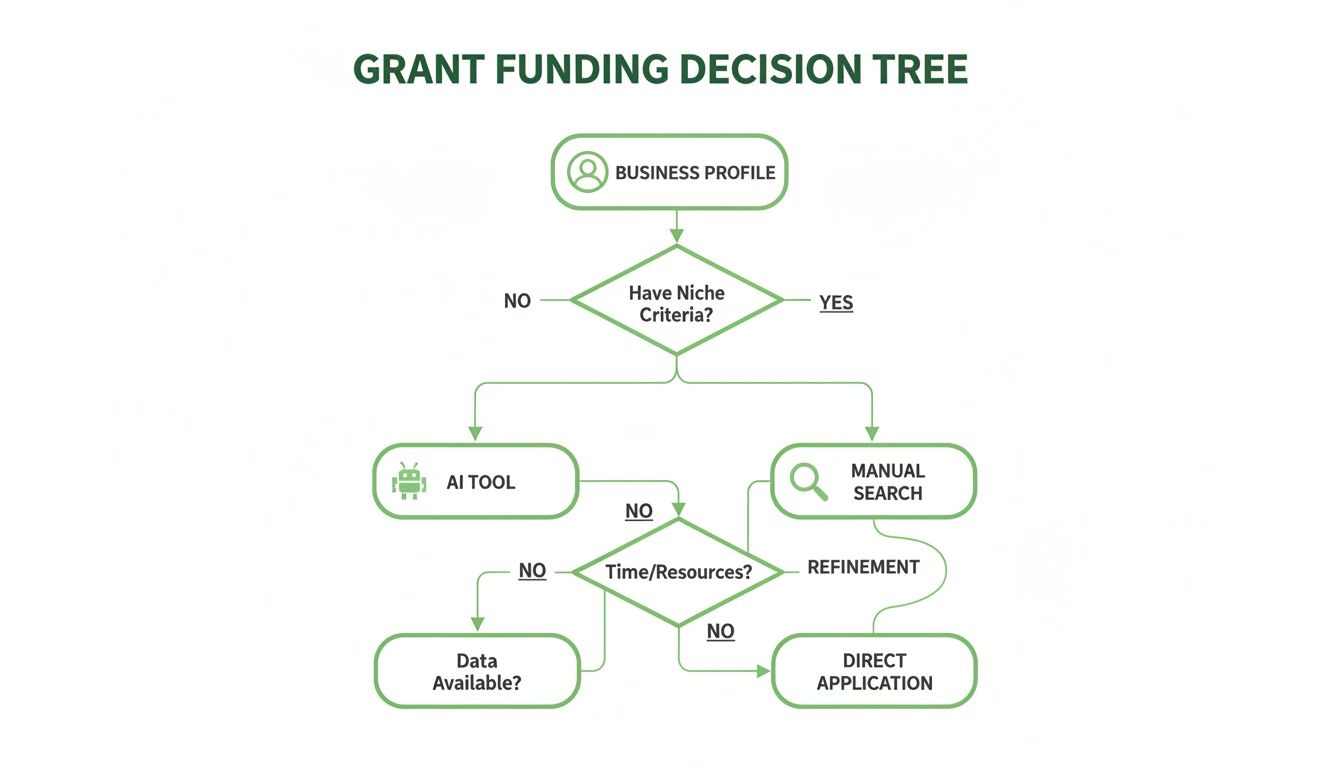
As you can see, using a tool designed for this purpose can shave off hours by filtering opportunities based on your specific business profile right from the start.
Interpreting What Funders Truly Want
Meeting the basic eligibility is one thing; genuine alignment is another beast entirely. Every single grant program has a "why" behind the money. Your job is to read between the lines of the program guide and understand that core mission. Are they trying to create jobs in a specific region? Boost export numbers? Encourage the adoption of clean technology?
Your application needs to scream, "My project helps you achieve your goals!" It’s not about what your business needs from them; it’s about how your project delivers the economic, social, or environmental impact the funder is paid to create. This is the critical shift in perspective where so many applications fall flat.
And it’s a widespread challenge. The Charity Insights Canada Project recently revealed a tough funding landscape where only 28% of organizations report a high success rate on their applications. With 64% of those organizations having staff who juggle grant writing with a dozen other duties, it's clear that finding the time to deeply analyze a funder's true intent is a major hurdle. You can read more about these insights on grant writing challenges and successes yourself. The data just confirms what many of us already know: you need an efficient system to pick your battles.
Creating a Prioritization Matrix
To bring some order to the chaos, I always recommend a simple prioritization matrix. You don’t need fancy software—a basic spreadsheet is perfect.
For each grant on your long list, score it from 1 to 5 on these key factors:
- Alignment Score: How perfectly does your project match the funder's core mission? (1 = It's a stretch, 5 = It's a perfect match)
- Eligibility Confidence: How certain are you that you meet every single mandatory requirement? (1 = Not sure, 5 = 100% confident)
- Effort to Apply: How much work is this application going to be? (1 = A mountain of work, 5 = Quick and easy)
- Funding Amount: How significant is the potential payout for your business? (1 = Nice but not essential, 5 = Total game-changer)
Once you've scored each opportunity, the real priorities will jump out at you. A grant that scores high on alignment and confidence but is low-effort to apply for is a clear "Quick Win." Go after that one first.
I see it all the time: businesses chase the biggest dollar amount, even when the project is a poor fit and the application is a monster. It's almost always more strategic to win three smaller, high-probability grants than to spend months on one long-shot application that goes nowhere.
Using Technology to Accelerate Triage
Manually vetting dozens of grants is a grind. It’s slow, tedious, and it’s easy to miss a crucial detail. This is where modern tools can give you a massive leg up. Platforms like GrantFlow are built to do this heavy lifting for you.
By plugging in your detailed business profile, these systems can pre-qualify grants automatically. They often assign a match score to each opportunity, instantly showing you how strong a fit it is based on dozens of data points. You can even filter for those "Quick Wins"—grants known for simpler applications or higher success rates—letting you focus your limited time where it will actually make a difference.
This kind of automated triage frees you from the drudgery of deciphering endless program guides. Instead, you can pour your energy into what really matters: crafting a powerful story for the grants you have the best chance of winning. It turns prioritization from a gut-feel exercise into a smart, data-driven strategy.
Crafting a Compelling Grant Application
Okay, you’ve sorted through the noise and have a prioritized list of grants that look like a great fit. Now the real work begins. Your focus needs to pivot from finding opportunities to actually winning them, and that comes down to persuasion.
Crafting a standout grant proposal isn’t about using fancy words or complex jargon. It’s about clear, strategic communication that draws a straight line between your project and the funder’s mission. A winning application is a package deal—every single piece has to do its job, from the executive summary that grabs their attention to the budget that proves you know your numbers. This is absolutely not the place for a one-size-fits-all approach.

Deconstructing the Core Components
While every grant has its quirks, most are built from the same set of essential pieces. Once you get a handle on these building blocks, you can create a powerful framework for your proposals. You'll still need to tailor the details, but you won't be starting from scratch every time.
Here are the key parts you’ll almost always encounter:
- Executive Summary: This is your elevator pitch on paper. It’s a punchy, one-page snapshot of your entire proposal, and its only job is to hook the reviewer and make them want to read more.
- Problem Statement or Needs Assessment: This is where you lay out the specific problem your project is going to solve. You have to back it up with data and make it crystal clear why it matters to this specific funder.
- Project Plan and Methodology: Here’s where you get into the what and the how. You’ll detail your objectives, the specific activities you’ll undertake, your key milestones, and a realistic timeline to get it all done.
- Budget and Financials: This is a line-by-line breakdown of every cost. It needs to be precise, well-justified, and show the funder that you’ll be a responsible steward of their money.
- Impact Metrics and Evaluation: This final piece is all about measuring success. It answers the most important question for any funder: "How will we know this project actually worked?"
Think of these components as chapters in a story. You’re guiding the reviewer from understanding a critical problem to believing in your solution and, finally, trusting you with the funds to make it happen.
Tailoring Your Narrative to the Funder
Generic applications get generic rejection letters. It’s that simple. The single most important rule in grant writing is customization. Every word in your proposal needs to be written with the funder’s guidelines, priorities, and even their specific language in mind.
Let's say you're a tech startup applying for two different grants:
- An Innovation Grant focused on R&D and creating new intellectual property.
- A Regional Economic Development Grant focused on creating jobs.
For the innovation grant, you’d go deep on the technical novelty of your project, your patent strategy, and the path to commercialization. But for the economic development grant? You’d pivot the entire story to focus on how this project will create 15 new high-paying jobs in the local community over the next two years. Same project, totally different story.
Here's a common mistake I see all the time: people write about what their business needs. You have to flip that perspective. Frame your proposal around what the funder needs—they need to fulfill their mandate, hit their KPIs, and report success to their own stakeholders. Your project is just the vehicle that helps them get there.
Accelerating Your Application Workflow with Modern Tools
Customizing every application sounds like a ton of work, because traditionally, it has been. This is exactly where modern grant writing platforms like GrantFlow come into play. Instead of staring at a blank page for every new opportunity, you can use specialized tools to build high-quality, tailored applications in a fraction of the time.
This system-driven approach means you can seriously increase the number of grants you apply for without letting the quality slip. Here’s a peek at how it works:
- AI Application Writer: This isn't about letting a robot write your proposal. Think of it as a way to generate a strong first draft. You feed it the context of the grant and your project, and an AI assistant can draft tailored responses for sections like the problem statement or project description. You then step in to refine and perfect it. It completely solves the "blank page" problem.
- Form Assistant: Grant applications come in all shapes and sizes—online portals, fillable PDFs, you name it. A form assistant can automatically populate these documents with your standard company info, saving you from the soul-crushing task of typing the same details over and over again.
- Content Library: This becomes your single source of truth. You can store and organize all your key information—company history, team bios, project descriptions, budget templates—in one central, reusable library. When a new application asks for that info, you can pull it in instantly, ensuring everything is consistent and accurate.
When you combine these tools, you’re not just writing applications; you’re building an application engine. The first one might take a bit of time to set up as you populate your Content Library. But the second, third, and fourth get progressively faster. This is the kind of efficiency that allows small teams to compete for grant writing opportunities at a scale that was impossible just a few years ago, turning what was once a resource-draining chore into a sustainable growth strategy.
Keeping the Grant Lifecycle Under Control
Winning a grant isn't the end of the road; it’s really just the beginning of a long-term relationship with a funder. True success isn’t about landing one big cheque. It's about creating a solid, repeatable system for handling the entire cycle—from finding and applying to reporting and communicating. This operational backbone is what separates the one-hit wonders from businesses with a predictable stream of grant funding.
Without a system, you're always playing catch-up. Deadlines seem to appear out of nowhere, reporting becomes a last-minute scramble, and crucial details inevitably get lost in a mess of emails and documents. A structured approach turns that chaos into a well-oiled machine, ensuring nothing important ever falls through the cracks.
Set Up Your Grant Management Command Centre
Your first move should be creating a central hub for everything grant-related. You could start with a simple spreadsheet, and that might work for a little while. But as soon as you start managing more than a couple of opportunities, you'll outgrow it fast. A dedicated platform is the way to go to keep everything organized and accessible for your whole team.
Your command centre absolutely needs to track a few key things for every single grant:
- Key Dates: Don't just track the final submission deadline. Think about all the smaller dates leading up to it—when the first draft is due, when reviews need to happen, and when you need to have those letters of support locked in.
- Application Status: A simple visual tracker, like a Kanban board, is perfect for this. Set up columns for ‘Identifying,’ ‘Applying,’ ‘Submitted,’ ‘Awarded,’ and ‘Reporting.’ It gives you a bird's-eye view of your entire pipeline at a glance.
- Funder Contacts: Who’s your program officer? What’s their email and phone number? Keeping this info handy is non-negotiable for building strong relationships.
- Reporting Requirements: The moment you win a grant, log every single reporting deadline and what’s required. Don’t wait.
This isn't just about avoiding a last-minute panic. It’s about being strategic. When you can clearly see your entire pipeline, you can make smarter decisions about how to balance your team's workload and focus everyone's energy on the most promising grant writing opportunities.
The Real Work: Post-Award Management
Getting the "yes" is a great feeling, but the real work of grant management kicks in right after you get that award notice. This is where being meticulously organized really pays off. If you drop the ball on compliance, you could easily put future funding at risk.
Your post-award responsibilities are not optional. They usually involve financial reporting, progress updates, and measuring your impact. Funders need to see that you’re using their money effectively and delivering on your promises. A well-organized process makes it simple to pull the data you need and get comprehensive, on-time reports out the door.
And the workload is no joke. Just look at the numbers. In the 2024-2025 fiscal year, SSHRC processed 14,100 applications and gave out over 5,000 new grants. Some programs, like the Insight Grants, had a respectable 34% success rate with an average award of $171,601. But the effort involved is staggering—a single tri-council application can easily take over 120 hours of work. You can dig into more of these facts and figures on federal grant competitions yourself. It just goes to show why you need an efficient system to manage the whole process, from that first draft to the final report.
Work Smarter with Collaboration and Automation
Let’s be honest: managing this entire lifecycle is a team effort. Using a collaborative platform gets everyone on the same page, whether they’re writing content, crunching the numbers for the budget, or tracking project metrics.
One of the most common ways small businesses fail at this is by letting all the grant knowledge live in one person's head. What happens when that person goes on vacation or, worse, leaves the company? The whole grant program grinds to a halt. A centralized system solves this problem by making the information available to everyone.
Modern tools are built to handle this. Think automated deadline reminders, shared to-do lists, and a central spot for all your documents. These features prevent critical steps from getting missed. For example, a tool like GrantFlow doesn't just help you find grants; it gives you the project management framework you need to see them through from start to finish. An application tracker keeps the whole team aligned, freeing you up to focus on the high-value work: building relationships and writing a story that funders can't ignore.
Your Grant Writing Questions, Answered
Jumping into the world of grant funding can feel a bit overwhelming, and it's totally normal to have a few questions before you dive in. Here are some straightforward answers to the questions we hear most often from Canadian business owners and consultants trying to get a handle on grant funding.
How Much Time Does a Grant Application Actually Take?
This is a classic "how long is a piece of string?" question. The truth is, the time commitment can swing wildly. A simple provincial wage subsidy might only need 10-20 hours of your time. But if you're tackling a major federal research grant from an agency like SSHRC or CIHR, you could easily sink over 120 hours into it.
What makes the difference? It really boils down to the program's complexity, the amount of cash on the table, and how organized your team is from the get-go. This is exactly why a systematic approach is a game-changer. By using tools with built-in content libraries and AI assistance, you can realistically slash that time commitment by 50-70%. That means you can get more high-quality applications out the door without burning out your team.
What are the Most Common Stumbles You See?
After seeing thousands of applications, you start to notice the same mistakes popping up again and again. Knowing what these tripwires are is the first step to sidestepping them entirely.
- Chasing ineligible grants: This is, without a doubt, the biggest time-waster. You absolutely must confirm you tick every single mandatory box before you write a single word.
- Sending a copy-paste proposal: Funders have a sixth sense for generic, one-size-fits-all applications. It instantly tells them you haven't bothered to understand what they care about.
- Fudging the budget: A budget that's vague or poorly justified screams "we haven't thought this through." It completely undermines a funder's confidence that you can manage their money responsibly.
- Missing the deadline: It sounds so basic, but it happens constantly. This is where an automated platform becomes your best friend—it helps pre-qualify opportunities, makes it easier to create tailored applications, and keeps those deadlines front and centre.
The most successful grant seekers are ruthless prioritizers. They don’t just ask, "Can we apply for this?" They ask, "Should we apply for this?" Answering that second question honestly saves an incredible amount of wasted effort.
Should I Hire a Grant Writer or Use a Platform?
There’s no single right answer here—it really depends on your company’s resources and goals. Bringing in a grant writing consultant gives you instant access to deep expertise, but that expertise comes at a price, usually a hefty retainer or a cut of the grant money.
A platform like GrantFlow, on the other hand, gives your own team the tools to manage the whole process for a predictable monthly fee. It’s a fantastic option if you want to build that grant writing muscle in-house, keep total control over your story, and go after multiple grants all year long. Funnily enough, many consultants are now using these exact platforms to manage their own client work more effectively, which just goes to show how powerful a system-driven approach can be.
Ready to stop leaving free money on the table and build a system that actually wins grants? GrantFlow is the AI-powered platform built specifically to help Canadian small businesses find, manage, and win funding. Start your free trial today and discover the opportunities you’ve been missing.
Continue reading

Mastering Your 2026 Agenda for an Annual General Meeting
Draft a compliant agenda for an annual general meeting in Canada. Covers legal items, virtual meetings, & aligning your 2026 AGM with grant funding goals.

Grant Money for Disabled: A Canadian Funding Guide
Find grant money for disabled Canadians. Our 2026 guide covers federal & provincial benefits, business grants, eligibility, and how to apply successfully.

Home Improvement Grants Canada: A Complete 2026 Guide
Unlock Canadian home improvement grants in 2026. Our guide covers federal, provincial, and municipal funding for homeowners and businesses. Learn how to apply.