

Matching Funds for Grants: A Guide to Boost Startup Funding
When a grant application asks for "matching funds," it can feel a little confusing at first. Why would a funder offer you money, only to ask you to put up some of your own?
Think of it less as a hurdle and more as a partnership. Funders want to see that you're just as invested in your project's success as they are. By asking you to contribute a portion of the project costs, they're ensuring you have real "skin in the game." This shared investment shows you're committed and confident in your plan, which makes your application much stronger.
What Are Matching Funds and Why They Matter

At its core, a matching fund requirement is a way for funders to make sure their investment will go the distance. They aren't just handing out money; they're strategically backing projects they believe will deliver a meaningful social, economic, or technological return.
Requiring a match is a smart way to filter for the most dedicated applicants. When you put your own resources on the line, it sends a powerful signal to the granting agency. It says you believe in your project's potential and are prepared to do the work to make it a reality.
A Powerful Tool for Shared Investment
This model shifts the dynamic from a simple handout to a true partnership. Everyone involved is working toward the same goal, which naturally leads to greater accountability and a sharper focus on achieving results.
We’ve seen this work on a massive scale right here in Canada. In 2021, the Government of Canada teamed up with UNICEF Canada for the #GiveAVax Fund. For every dollar donated by an individual, the federal government matched it. Canadians generously gave $9,675,928, which the government matched to create a total fund of $19,351,857. This incredible initiative doubled the campaign's impact, perfectly illustrating the power of a matching fund model.
The Benefits for Your Business
While it might seem like extra work, meeting a matching requirement actually offers some real advantages for your business. It's an opportunity to strengthen your entire project.
Successfully securing your match can:
- Boost Your Credibility: It shows funders you're resourceful and have a well-thought-out financial strategy.
- Sharpen Your Planning: It forces you to get serious about budgeting, cash flow, and resource management.
- Build Community Support: The process of finding a match often connects you with new partners, investors, or local stakeholders, creating a valuable support system for your project.
Fundamentally, a matching fund requirement is a test of your project's foundation. Grantors want to see that you've built a sustainable plan, not just a proposal dependent on a single cash infusion. It’s their way of ensuring their investment is built on solid ground.
Seeing the "why" behind the requirement changes everything. It’s not a barrier; it's a strategic part of the funding process designed to set projects up for success. For Canadian entrepreneurs, getting comfortable with this concept is a crucial step toward unlocking some of the best grants for small business.
Decoding Cash vs. In-Kind Contributions
When a grant application mentions a "match," many people's minds jump straight to a big pile of cash. But that’s not always the case. Funders know that value comes in many forms, which is why matching funds are typically broken down into two main categories: cash and in-kind contributions.
Getting a handle on the difference is crucial. It can open up a world of possibilities for meeting your grant obligations, especially if your cash flow is tight. While one is as simple as writing a cheque, the other is about getting creative and recognizing the value of the resources you already have.
The Power and Simplicity of a Cash Match
A cash match is exactly what it sounds like: real dollars and cents your organization commits to the project. This is often the preferred form for funders because it's straightforward, easy to track, and leaves no room for interpretation. It’s clean and simple.
The good news is that this cash doesn't have to come from just one place. You have a few options for pulling it together.
- Business Revenue: This is the most common source—simply using your company's operating capital or profits.
- Secured Loans: Funds from a business line of credit or a term loan specifically earmarked for the project can often count.
- Investor Capital: Money you've raised from angel investors or venture capitalists is another valid source.
- Other Grants: This one comes with a big "maybe." Sometimes, you can use funds from one grant to match another, like using provincial money to match a federal grant. You absolutely must check the guidelines of both grants to see if this is allowed.
A strong cash match sends a powerful signal to the funder. It shows you have skin in the game, financial stability, and a serious commitment to seeing the project succeed.
Unlocking Value with In-Kind Contributions
Now for the more creative side of the coin: in-kind contributions. These are non-cash donations of goods, services, or even time that are essential for the project and have a clear, documentable value.
Here's a simple way to think about it: if you'd have to pay for it anyway for the project to succeed, it can probably be counted as an in-kind match. For startups and small businesses, this is a total game-changer. It lets you meet a big matching requirement without having to drain your bank account.
An in-kind contribution is a way to get credit for the value you're already bringing to the table. It’s a formal recognition that your time, expertise, and existing assets are just as valuable as cash in achieving the project's goals.
So, what does this look like in the real world?
- Donated Labour: The value of your own staff's time spent working directly on the grant project.
- Volunteer Time: The value of skilled volunteers, like a marketing expert who helps with your campaign or a web developer who builds out a new feature.
- Existing Equipment: Using specialized machinery, software licences, or computers your company already owns for the project.
- Donated Office Space: The market value of the portion of your office or facility used specifically for the project activities.
- Professional Services: Pro-bono legal, accounting, or consulting services offered by a partner firm.
Assigning a Fair Market Value
The entire concept of in-kind contributions hinges on one critical element: calculating their Fair Market Value (FMV). This isn't just a number you pull out of thin air. It’s the price that good or service would realistically cost in the open market, and you need to be able to back it up.
For example, to value your staff's time, you’d use their regular hourly wage plus a reasonable percentage for benefits. To value donated equipment, you might get a quote for what it would cost to rent the same machine for the same amount of time. Grant reviewers will look at these numbers closely, so solid documentation is a must.
The Government of Canada offers clear guidance on how to determine the value of non-cash gifts, and the principles apply perfectly here.
This advice from the Canada Revenue Agency really drives the point home. It’s all about justifying what a willing buyer would pay a willing seller. That’s precisely the standard that grant assessors use when they check if your in-kind valuations are credible.
How to Calculate Grant Matching Ratios
When you start digging into grant applications, you'll inevitably run into terms like a 1:1 or 2:1 match. It can feel like you’re back in high school math class, but trust me, the concept is much simpler than it looks. These ratios are just the funder's way of telling you exactly how much skin they expect you to have in the game.
Think of it like you’re splitting the cost of a new piece of equipment with a business partner. A 1:1 ratio is a straight 50/50 split—you both put in an equal share. When the ratio is 2:1, it just means one partner (in this case, the funder) is covering a bigger piece of the pie. Getting comfortable with this math is the first step to building a realistic project budget that won't give you any surprises later on.
Your contribution can come in a couple of different flavours: cold, hard cash or valuable in-kind resources.
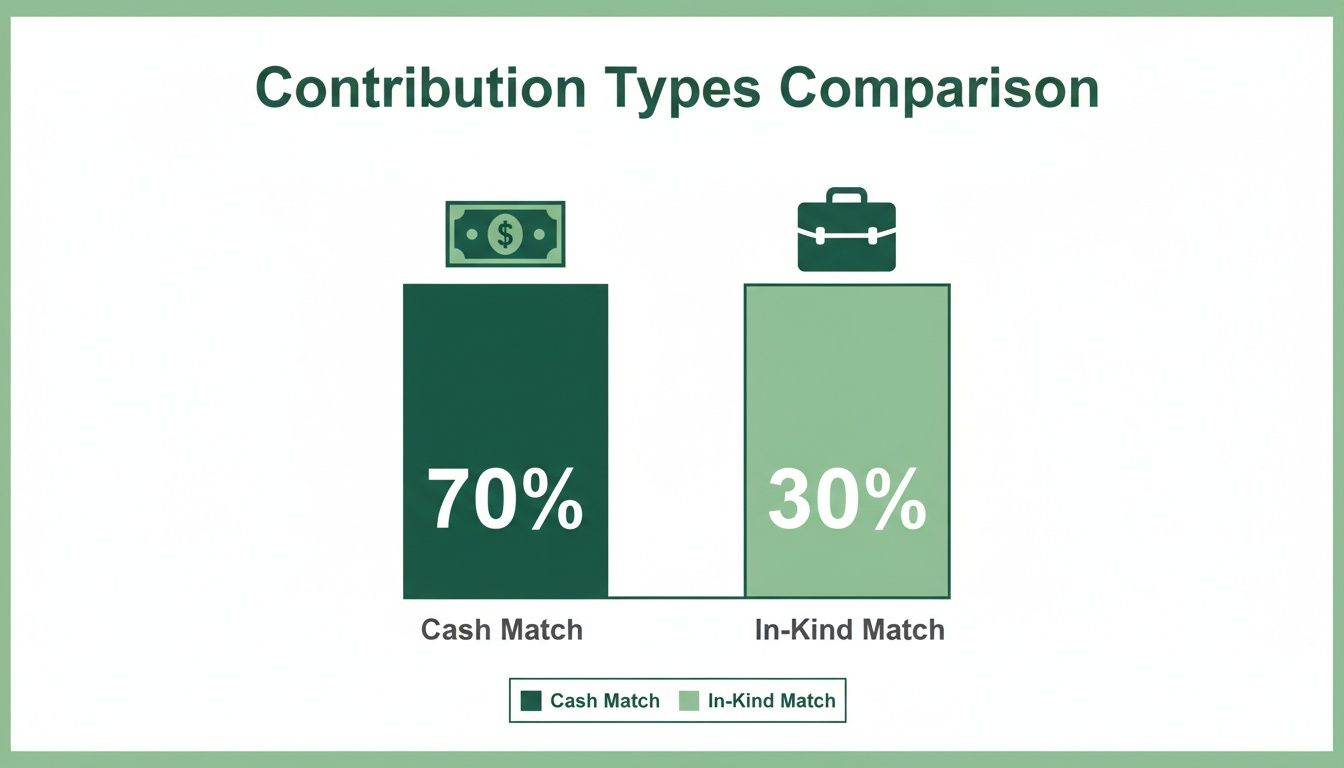
The good news is that most funders accept both, which gives you some welcome flexibility when you're pulling your share of the project funding together.
Cracking the Ratio Code
Grant guidelines almost always state the matching ratio as (Funder:Applicant). The first number is their piece, and the second number is yours. So, a 3:1 ratio simply means the funder will put in three dollars for every single dollar you contribute. It’s that straightforward.
Here are the most common ratios you’ll see out in the wild when you’re looking for matching funds for grants:
- 1:1 Match (50% Match): This is the classic. For every dollar the funder provides, you need to match it with a dollar of your own. It's an even partnership.
- 2:1 Match: For every two dollars from the funder, you chip in one dollar. This means the funder is footing two-thirds of the bill.
- 3:1 Match: The funder contributes three dollars for every one you bring to the table. In this scenario, they’re covering a generous 75% of the project costs.
The real secret to making these calculations a breeze is to think in "parts." A 1:1 ratio has two total parts (1+1). A 2:1 ratio has three total parts (2+1). Once you get that, the math becomes second nature.
A Step-by-Step Guide to Calculating Your Share
Let’s put this into practice with a real-world example. The simplest way to figure out your required match is to start with your total project cost.
To make it easy, let's say your project has a total budget of $100,000. The table below shows how your required contribution changes based on the funder's ratio.
| Sample Matching Fund Calculations | |||
|---|---|---|---|
| Matching Ratio (Funder:Applicant) | Grant Amount Received | Your Required Match | Total Project Budget |
| 1:1 | $50,000 | $50,000 | $100,000 |
| 2:1 | $66,667 | $33,333 | $100,000 |
| 3:1 | $75,000 | $25,000 | $100,000 |
As you can see, a more generous ratio from the funder significantly reduces the amount you need to bring to the project, making your goals much more attainable.
Breaking Down the Math
Want to see how we got those numbers? Here's the play-by-play.
Scenario 1: A 1:1 Matching Ratio
- Add the ratio parts: 1 (funder) + 1 (applicant) = 2 total parts.
- Find the value of one part: $100,000 (total cost) ÷ 2 (total parts) = $50,000 per part.
- Figure out each share:
- Your Match (1 part): 1 x $50,000 = $50,000
- Grant Amount (1 part): 1 x $50,000 = $50,000
Scenario 2: A 2:1 Matching Ratio (Funder:Applicant)
- Add the ratio parts: 2 (funder) + 1 (applicant) = 3 total parts.
- Find the value of one part: $100,000 (total cost) ÷ 3 (total parts) = $33,333 per part.
- Figure out each share:
- Your Match (1 part): 1 x $33,333 = $33,333
- Grant Amount (2 parts): 2 x $33,333 = $66,666
This "total parts" method takes all the guesswork out of the equation. By focusing on the total project budget first, you can walk into any grant application knowing exactly what your financial commitment needs to be. No more uncertainty.
Creative Strategies for Sourcing Your Match

Finding the money for your grant match can feel like the toughest part of the whole application. While dipping into your company’s revenue is the most straightforward option, it’s definitely not the only one. Getting creative with how you source your match doesn’t just make bigger projects possible; it also proves your resourcefulness to the funder.
This is about more than just finding cash. It’s about building a solid financial strategy that pulls from different places. By looking at loans, investors, and even clever partnerships, you can build a much stronger case.
Tapping into Private Capital and Credit
When your operating budget is already doing all the heavy lifting, the next logical step is to look beyond your day-to-day cash flow. Private funding is often more flexible and can be secured much faster than other grants, giving you the cash you need to confidently commit to your match.
Here are a few powerful options to consider:
- Business Line of Credit: This is one of the most useful tools you can have. A line of credit gives you a pool of funds to draw from as needed, which is perfect for covering your share of project costs without messing up your regular finances.
- Angel Investors and Venture Capital: If you’ve recently closed a funding round or have investors on board, those funds can often be put toward your grant match. This sends a strong signal to funders that private investors have already kicked the tires and believe in what you're doing.
- Crowdfunding Campaigns: For projects that really resonate with the public, a dedicated crowdfunding campaign can be a brilliant way to raise your match. This approach also gives you hard data on public interest in your project—a very compelling detail for any grant application.
The Art of Grant Stacking
One of the smartest but most overlooked strategies out there is grant stacking. This is simply the practice of using funds from one grant to meet the matching requirement for another. Picture this: you use a provincial innovation grant to satisfy the match for a much larger federal R&D program.
This technique can be a game-changer, but there’s one golden rule: you have to make sure it’s allowed. You need to comb through the guidelines for both grant programs. Some funders, especially at the federal level, might say you can't use other federal funds as a match, but they'll happily accept provincial or municipal money. Getting this kind of layered support from different levels of government makes your application incredibly strong.
Grant stacking shifts your funding approach from a checklist of separate applications to an interconnected strategy. When it's permitted, it creates a multiplier effect where every dollar you secure helps unlock the next one, building serious financial momentum for your project.
Forging Strategic Partnerships and Alliances
Remember, your match doesn't have to come entirely from your own pockets. Teaming up with other businesses or community groups is a fantastic way to pool resources and share the financial load. A good strategic partnership can bring both cash and valuable in-kind contributions to the table.
Think about other organizations that would benefit from your project's success.
- Industry Collaborators: Is there a larger company in your supply chain that stands to gain if your project succeeds? They might be willing to chip in financially or offer in-kind resources like specialized equipment or expert staff time.
- Community Organizations: Non-profits or local foundations whose missions align with your project could be ideal partners to help contribute to your match.
- Supplier Negotiations: Don’t underestimate the power of your existing business relationships. You could negotiate with a key supplier to provide materials or services at a reduced cost—or even as a donation—which can then be documented as a legitimate in-kind contribution.
This collaborative model is used even at the highest levels. For instance, Canada's international assistance, which hit $15.5 billion in 2022-2023, often relies on a matching structure to maximize its impact. A great case in point is the Equality Fund, where a $300 million government commitment is designed to attract further private investment, similar to how a startup might stack provincial and federal grants. You can read more about how Canada's international assistance programs leverage matching funds to hit their goals.
By exploring these different avenues, you can build a matching funds strategy that is both robust and impressive. If you’re looking for programs built on this model, you might be interested in our overview of the EDC Investment Matching Program, which is a fantastic example for growing Canadian businesses.
Getting Your Paperwork in Order: Documentation and Financial Tracking

Landing the commitment for your matching funds for grants feels like a huge win, and it is. But it’s really only half the job. Now you have to prove every single dollar was spent exactly as you said it would be. This is where meticulous documentation and clear financial tracking come in—they aren't just good habits; they are absolute must-haves that can define your relationship with a funder.
Think of your records as the official story of your project's money. When a reporting deadline hits or an auditor comes knocking, that story needs to be crystal clear and backed by evidence. Any fuzzy details, gaps, or questionable valuations can throw up a red flag, putting your current grant at risk and potentially souring your reputation for future funding.
The trick is to build your tracking system from day one. It’s the single best way to manage risk. Doing this turns reporting from a frantic, last-minute scavenger hunt into a simple, routine task, letting you focus on your actual project work.
Creating an Audit-Proof Trail
Your mission is to build a paper trail so solid that an auditor could follow the entire financial journey of your project without having to ask you a single question. This means keeping separate, organized records for your cash and your in-kind contributions, because they each need different kinds of proof.
For your cash match, the evidence has to be direct and undeniable.
- Bank Statements: You'll want to highlight the exact transactions showing your matching funds moving.
- Cancelled Cheques: These are perfect for showing a direct payment from your account for a project expense.
- Paid Invoices & Receipts: Make sure these clearly detail what was purchased for the project, proving the money was used as intended.
- Payroll Records: If staff salaries are part of your cash match, you’ll need detailed payroll reports showing their time allocated to the project.
For in-kind contributions, the game is all about justifying the Fair Market Value (FMV) you’ve claimed.
- Signed Timesheets: For any contributed time (staff or volunteer), you need logs with dates, hours, a description of the work done, and a signature.
- Letters of Valuation: When you receive donated equipment or professional services, get a formal letter from the donor. It should state the item's FMV and confirm it was contributed to your project.
- Rental Agreements or Market Analyses: To put a value on donated space, you could use a lease for a similar space or a quick analysis of what comparable spaces rent for in your area.
Weaving Tracking into Your Day-to-Day Finances
A messy, hastily-made spreadsheet is an auditor's nightmare—and a major headache for you. The key to staying compliant without the stress is to be proactive. As soon as that grant agreement is signed, set up a dedicated tracking system within your accounting software.
Treat the grant funder like a major client or project. The best thing you can do is create a specific project code in your accounting system. Tag every single expense and contribution related to the grant with this code. It makes pulling accurate reports almost effortless.
When you organize your books this way, every transaction gets categorized correctly from the get-go, whether it’s coming from the grant or your own matching funds. This not only makes your reporting a breeze, but it also gives you a real-time snapshot of your project's financial health. Funders love to see this level of professionalism and accountability.
Building Your Grant Application Checklist
Turning your funding strategy into a successful application isn’t magic—it’s about having a rock-solid process. Think of a detailed checklist as your secret weapon for making sure every piece of your matching funds for grants is perfectly prepared, presented, and documented. This organized approach takes the guesswork out of the equation and helps you build a compelling proposal that really stands out.
When you present a well-structured application, you’re sending a clear message: you're a reliable partner who knows how to manage a project's finances. By following a clear set of steps, you can confidently show your commitment and make your proposal far more competitive.
Pre-Submission Preparation
Before you type a single word of the application, you need to do your homework. This is the foundational stage where you dig into the requirements and take a hard look at your own resources. Getting this right from the start saves a lot of headaches later and strengthens your entire case.
Dissect the Grant Guidelines: Don't just skim the funder's instructions—live in them. Read them over and over until you know exactly what they want. Pinpoint the required matching ratio, what they’ll accept as eligible cash or in-kind contributions, and the specific documentation they need to see.
Conduct an Internal Resource Audit: It's time to take inventory. Create a detailed list of all your available assets. This means cataloguing potential cash sources (like revenue, loans, or investor capital) and every possible in-kind contribution (think staff time, equipment, or facility use). Be sure to assign realistic Fair Market Value estimates to everything.
Secure Official Commitments: A promise isn't enough; you need it in writing. Get signed letters of commitment from any partners providing funds, services, or goods. For your own internal resources, a formal memo signed by your leadership confirming the allocation is a must.
Assembling the Application Components
Once you have your commitments lined up, the next step is to weave them into the fabric of your grant proposal. Your goal is to present a crystal-clear financial picture that shows the shared investment you and the funder are making together.
A strong budget narrative is more than just numbers; it’s the story of your shared investment. It should clearly explain how your matching contribution directly supports the project's goals, demonstrating your commitment to achieving a successful outcome together.
Matching funds have long been a cornerstone of Canadian public funding, from international development assistance to domestic R&D tax credits. With government transparency initiatives, like the federal Grants and Contributions database launched in 2018, the need for meticulous documentation is more critical than ever. Being prepared with clear, auditable records is non-negotiable for navigating these systems. You can find more on this by exploring insights into Canada's donor and funding mechanisms.
Finally, get down to the details. Build a project budget with separate, clearly labelled columns for the grant funds you're requesting and your matching contributions. Then, write a compelling budget narrative that walks the reviewer through the source and purpose of every single line item in your match. This level of detail shows you've done your due diligence and helps build that all-important trust. To discover more ways to succeed, check out our guide on finding grant writing opportunities.
Your Top Questions About Matching Funds, Answered
When you're dealing with grant applications, matching funds often come with a lot of questions. Let's clear up some of the most common ones we hear from founders and grant writers so you can move forward with confidence.
Can I Use Another Grant as a Match?
Sometimes, yes! This strategy is often called "grant stacking," and whether it's allowed comes down to the specific rules of both funders. It's not uncommon for a Canadian federal program to let you use a provincial grant as your matching portion. Why? Because it shows your project has strong backing at multiple levels of government.
On the flip side, many funders will explicitly forbid using money from a similar source. For instance, you almost never see a federal grant being used to match another federal grant. The absolute best practice here is to read the fine print in both grant guides. If you're still not sure, don't guess—get on the phone with the program officer and ask for a clear 'yes' or 'no' before you submit anything.
What Happens If We Can't Secure the Promised Matching Funds?
This is a scenario you really want to avoid, as it can create some serious problems. If you fall short of your promised match, the funder might simply reduce their grant amount to reflect the actual contribution you managed to raise.
But it can get much worse. A funder could demand you repay any grant money they've already given you or even cancel the agreement altogether. This isn't just a financial headache; it can damage your organization's reputation and make it tougher to win grants down the road.
This is why it's so important to have your matching funds locked in before you sign a grant contract. Get signed letters of commitment for any donations and have your loan agreements finalized. This protects everyone involved.
How Do I Properly Value In-Kind Contributions?
Putting a dollar value on in-kind contributions isn't a guessing game; it needs to be a clear, defensible process. The standard you have to follow is Fair Market Value (FMV), which is simply what the item or service would cost if you had to buy it yourself.
Here’s a quick guide for the most common types of in-kind support:
- Volunteer Time: Don't just pick a number. Look up the typical hourly wage for a professional with those skills in your area. If a software developer volunteers for you, their time is valued at what a developer earns. Always back this up with signed timesheets detailing the hours and work completed.
- Donated Goods: This one is usually straightforward—the value is its current market price. If a local company donates brand-new laptops, their value is what you'd pay for them in a store.
- Professional Services: When a firm donates their expertise (like legal or accounting help), ask them for an official letter. It should outline the services they provided and state what their standard commercial rate would have been.
Ready to stop missing out on funding opportunities? GrantFlow is an AI-powered platform that finds every grant, tax credit, and loan your Canadian business qualifies for. Our tools help you write applications faster and track everything in one place, so you never miss a deadline. Start your 7-day free trial and discover your perfect funding match.
Continue reading

Mastering Your 2026 Agenda for an Annual General Meeting
Draft a compliant agenda for an annual general meeting in Canada. Covers legal items, virtual meetings, & aligning your 2026 AGM with grant funding goals.

Grant Money for Disabled: A Canadian Funding Guide
Find grant money for disabled Canadians. Our 2026 guide covers federal & provincial benefits, business grants, eligibility, and how to apply successfully.

Home Improvement Grants Canada: A Complete 2026 Guide
Unlock Canadian home improvement grants in 2026. Our guide covers federal, provincial, and municipal funding for homeowners and businesses. Learn how to apply.